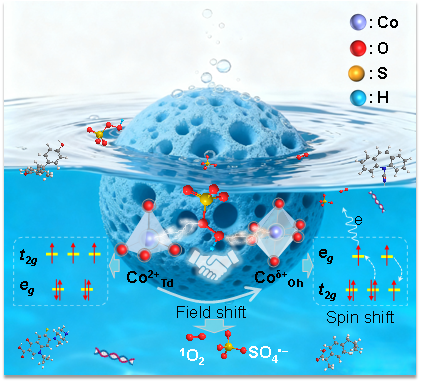
Single-atom catalysts (SACs) take a pivotal position in heterogeneous water purification, yet their deployment is restricted by poor yields, limited activity-stability and high costs. Here, A simple and economical “frustrated Lewis pairs”-assisted lattice confinement strategy is reported to construct tetrahedrally and octahedrally coordinated single-atom Co sites in millimetric γ-Al2O3 (SCoA) at a kilogram level, achieving site-specific spin state modulation of the lattice-confined Co. The flexible lattice confinement leverages the tetrahedral and octahedral site interactions to form high-spin-dominated Co(II) centres. Synergistic adsorption of Co-Al sites toward peroxymonosulfate induces an adaptive shift of high-spin Co(II) from a tetrahedral to octahedral site, which provides an efficient spin channel for both proton/electron transport and conversion of high-spin Co(II)/Co(III) into low-spin Co(III) in the octahedral site, lowering the energy barrier of synchronously producing SO4•− and 1O2. The unique mechanism sustains a high-efficient removal of multiple pharmaceuticals/antibiotics and antibiotic resistance genes. Notably, the estimated cost of SCoA at ≈$53/kg is 2300–2600 times cheaper than that of commercial 3d-transition metal SACs. Thus, the proposed framework of lattice confinement-augmented adaptive single-atom catalysis establishes a low-cost and versatile platform to address the issue of recalcitrant emerging contaminants, advancing clean water and water resilience against the global freshwater crisis.