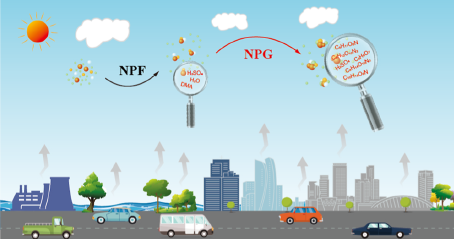
New particle formation (NPF) represents a major aerosol source with profound implications for air quality and global climate. While studies in heavily polluted megacities (e.g., Beijing) have typically revealed high nucleation rates coupled with slow particle growth, the mechanisms governing NPF under moderate pollution regimes remain poorly understood. Here, we report a distinct NPF pattern in the coastal city of Xiamen, characterized by relatively low nucleation rates but exceptionally rapid particle growth. Field observations and model simulations show that anthropogenic oxygenated organic molecules (OOMs), rather than sulfuric acid, dominate particle growth from the sub-3 nm size range. Despite a modest nucleation rate (J1.7 = 1.2 cm3 s−1), the observed high growth rate (GR7−15 = 7.2 nm h−1) is largely attributable to condensable organic vapors from anthropogenic sources. This efficient, anthropogenically driven growth pathway suggests that NPF could play a more substantial role in aerosol formation in many moderately polluted urban environments than currently recognized. We therefore urge the integration of such anthropogenic organic-driven growth mechanisms into atmospheric models to improve climate predictions.