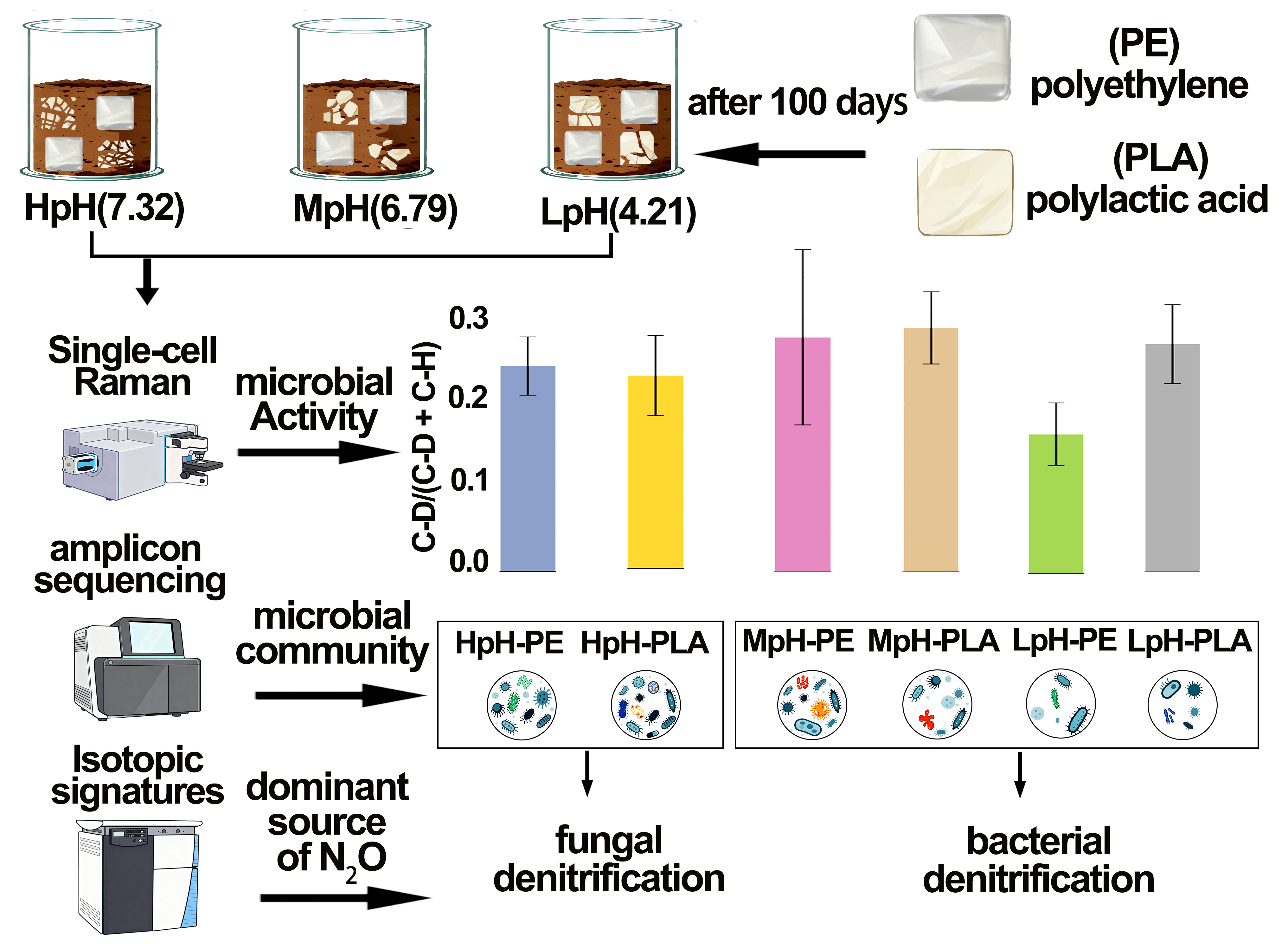
Soil acidification degrades agroecosystem quality, while plastic residues create distinct plastisphere niches in agricultural soils. However, how plastisphere microbiota regulate nitrogen transformations under soil acidification remains unclear. Here, microcosm experiments integrating acetylene inhibition, N2O isotopocule analysis, single-cell Raman–D2O probing, and bacterial 16S rRNA and eukaryotic 18S rRNA gene sequencing were used to investigate plastisphere-mediated denitrification along a soil pH gradient (4.17–7.82) in polyethylene (PE)- and polylactic acid (PLA)-amended soils. Soil acidification significantly altered soil physicochemical properties and inorganic nitrogen pools. Both PE and PLA plastispheres enhanced denitrification and N2O emission rates relative to bulk soil, with PLA showing stronger responses under acidic conditions. Along the acidification gradient, the dominant N2O production pathway shifted from fungal denitrification at high pH to bacterial denitrification at medium and low pH. Although acidification generally reduced microbial diversity and reshaped community composition, the PLA plastisphere maintained higher single-cell metabolic activity than PE and bulk soil under low-pH stress. Denitrification in the PLA plastisphere was also associated with a broader set of environmental and biotic factors, including bacterial, eukaryotic, and viral community attributes. These findings demonstrate that soil pH and plastic type jointly regulate plastisphere microbial community assembly, metabolic activity, and N2O production pathways in acidifying soils.