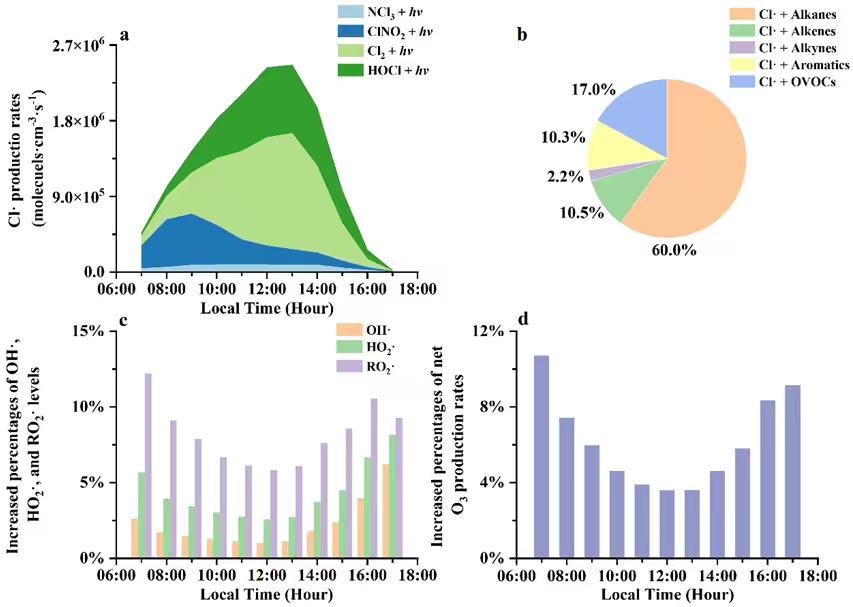
Chlorine atom (Cl) plays a crucial role in regulating atmospheric composition and air quality. Trichloramine (NCl3), a potential precursor of Cl, has not been thoroughly investigated in terms of sources and atmospheric implications. In this study, nocturnal peaks of NCl3 were frequently observed in a coastal city in Southeast China. Through integrated analysis of field measurements and machine learning modeling, nitryl chloride (ClNO2), molecular chlorine (Cl2), ultraviolet (UV) radiation, and ammonia (NH3) were identified as the predominant factors affecting the distribution of NCl3. Meanwhile, the generation of NCl3 may be primarily attributed to reactions involving ClNO2, Cl2, and NH3, while intense UV radiation induced its rapid loss via photolysis. Model simulations revealed that NCl3-driven chemistry substantially boosts Cl production, amplifying ROx· and O3 formation up to 10%. Our study not only fills the gap in observational research on NCl3 in coastal regions to some extent but also deepens the understanding of its atmospheric formation and loss mechanisms.